When people talk about 6G, the conversation often jumps straight to futuristic applications, AI-driven networks, holographic communications, or terabit speeds. Those ideas attract attention, but before any of them become reality, So, now let us look into United States 6G Spectrum and Future Wireless Planning along with Smart LTE RF drive test tools in telecom & Cellular RF drive test equipment and Smart Wireless Survey Software Tools & Wifi site survey software tools in detail.
Where will 6G operate?
Every generation of wireless technology has been built on spectrum availability. Without suitable spectrum resources, even the most advanced radio technology cannot move beyond research labs and demonstration environments.
That is why a significant amount of activity in the United States is currently focused on spectrum planning for the next decade. While commercial 6G deployments are still years away, government agencies, standards bodies, network operators, equipment vendors, and research organizations have already started preparing the foundation.
The work happening today will influence how wireless networks are designed, deployed, and expanded throughout the 2030s.
Why Spectrum Planning Starts So Early
Many people assume that wireless generations appear every ten years through software upgrades and new hardware releases. The reality is much different.
Spectrum identification, coexistence studies, interference analysis, international coordination, standards development, device ecosystem preparation, and regulatory approvals often require many years before commercial deployment begins.
The United States learned valuable lessons during the transition from 4G to 5G. Spectrum decisions made years before commercial launches directly affected coverage, capacity, and deployment speed.
For 6G, regulators are trying to avoid delays by starting the planning process much earlier. The objective is simple: ensure that spectrum resources are available when operators are ready to build future networks.
The Growing Attention on Mid-Band Spectrum
One of the strongest themes in current U.S. discussions is the search for additional mid-band spectrum.
Low-band frequencies provide wide coverage but limited capacity.
Millimeter-wave frequencies offer very high throughput but require dense infrastructure.
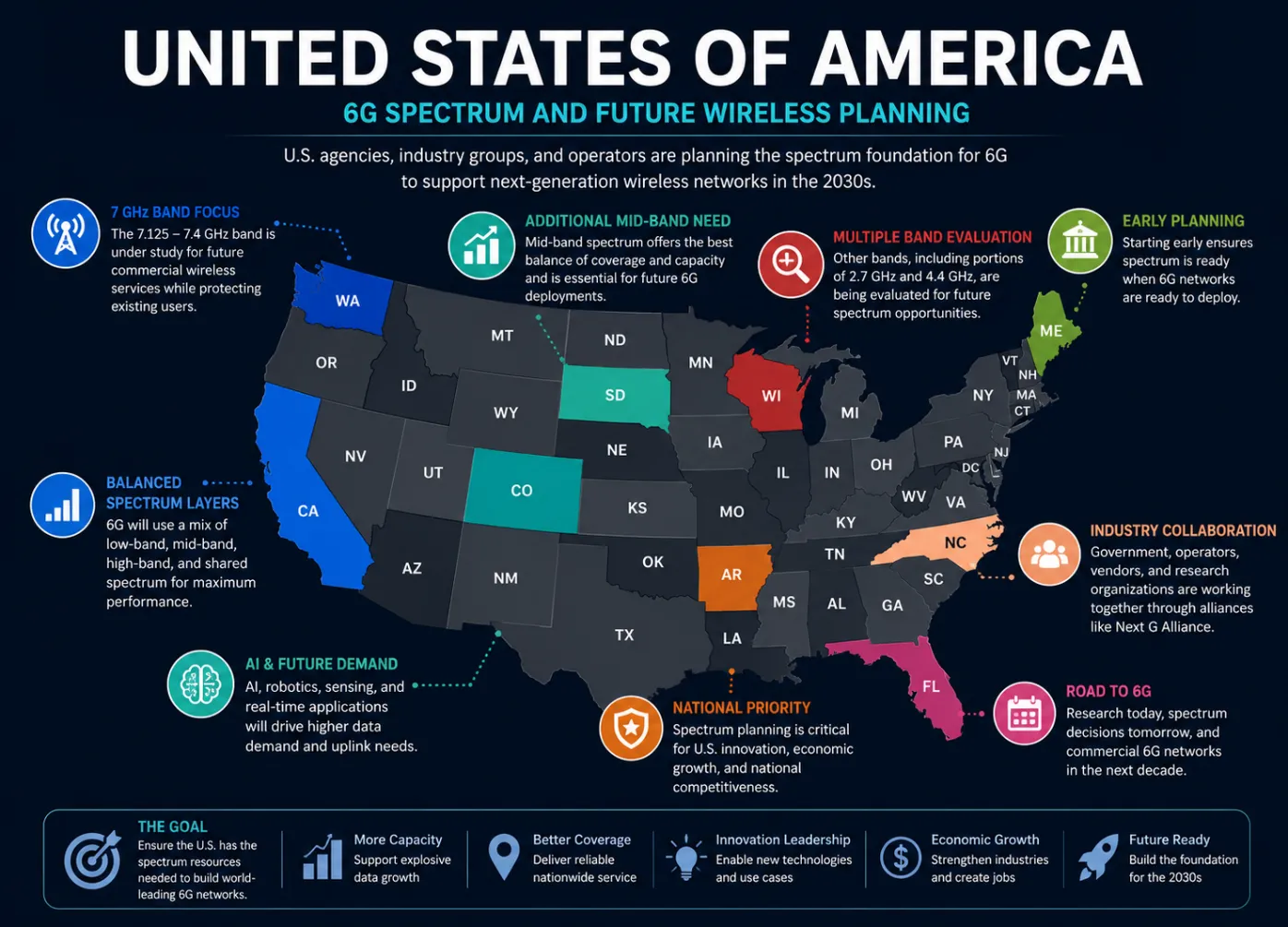
Mid-band spectrum continues to provide the best balance between coverage and network capacity. Because of this, many experts believe that future 6G deployments will rely heavily on new mid-band resources.
Several studies and industry groups have identified the need for large blocks of spectrum that can support future applications, higher uplink requirements, AI-driven services, advanced sensing functions, and increasingly data-intensive workloads.
The 7 GHz Band Is Receiving Significant Attention
One frequency range receiving considerable attention in the United States is the 7.125 GHz to 7.4 GHz band.
Government agencies are actively studying this range to understand how it can support future commercial wireless services while maintaining protection for existing users.
This work is not limited to technical evaluations. It also includes policy discussions, coexistence analysis, relocation requirements, and long-term spectrum management planning.
The outcome of these studies may play a major role in determining how future 6G networks are deployed across the country. Industry observers increasingly view this spectrum range as one of the leading candidates for future 6G expansion.
Beyond One Spectrum Band
Planning for 6G is not focused on a single frequency range.
U.S. agencies are also evaluating other bands, including portions of the 2.7 GHz and 4.4 GHz ranges, to determine whether additional commercial opportunities exist in the future.
This broader approach reflects an understanding that next-generation networks will likely require a mix of licensed, shared, and unlicensed spectrum resources.
Future wireless systems may need to operate across multiple frequency layers simultaneously, depending on the service being delivered and the location of the user.
The goal is to create enough flexibility so that operators can meet future traffic requirements without facing severe spectrum shortages.
The Role of the Next G Alliance
A major contributor to North America’s 6G planning efforts is the Next G Alliance.
The organization brings together industry participants from equipment manufacturers, mobile operators, research institutions, government agencies, and technology companies.
Its work extends beyond radio technology.
Current activities include spectrum planning, technology roadmaps, sustainability, integrated sensing, AI applications, digital twins, non-terrestrial networks, and future deployment strategies.
The objective is to ensure that North America remains actively involved in shaping global 6G standards and future wireless innovation.
AI Will Influence Future Spectrum Demand
One noticeable difference between 5G and 6G discussions is the growing influence of artificial intelligence.
Future wireless networks are expected to support AI applications at the network edge, autonomous systems, industrial automation, connected robotics, sensing applications, and real-time data processing.
These services can generate traffic patterns that differ from traditional smartphone usage.
For many years, wireless networks were primarily designed around downlink traffic. Future applications may require stronger uplink performance because devices will continuously send data, sensor information, video streams, and machine-generated content back to the network.
This shift is one reason why regulators and industry groups are evaluating larger spectrum resources for future deployments.
Spectrum Is Also a National Competitiveness Issue
Wireless technology has become closely connected with economic growth, research leadership, manufacturing capability, and national security.
For this reason, spectrum planning discussions in the United States are no longer viewed solely as telecommunications issues.
Government agencies increasingly see future wireless infrastructure as part of a broader technology strategy.
International spectrum decisions, standardization activities, and global wireless leadership are all connected.
As countries prepare for future international spectrum conferences and next-generation standards development, the United States is working to ensure that its interests are represented early in the process.
What This Means for Mobile Operators
Although commercial 6G networks remain several years away, operators are paying close attention to these developments.
Spectrum decisions made today directly affect future investment plans.
Network architecture, radio hardware development, chipset design, infrastructure planning, and deployment economics all depend on knowing which spectrum resources will be available.
Operators also need sufficient time to prepare equipment ecosystems, testing programs, and deployment strategies.
The earlier spectrum clarity becomes available, the easier it becomes to prepare for future rollouts.
| Topic | Key Takeaway |
| Country | United States |
| Focus Area | 6G Spectrum Planning and Future Wireless Infrastructure |
| Primary Objective | Prepare spectrum resources for commercial 6G deployment in the 2030s |
| Why Planning Starts Early | Spectrum allocation, coexistence studies, standards development, and regulatory approvals take many years |
| Key Spectrum Priority | Identification of additional spectrum resources for future 6G networks |
| Most Discussed Band | 7.125 GHz – 7.4 GHz (7 GHz Band) |
| Why the 7 GHz Band Matters | Potential candidate for future commercial 6G wireless services |
| Additional Bands Under Study | Portions of the 2.7 GHz and 4.4 GHz frequency ranges |
| Importance of Mid-Band Spectrum | Best balance between network coverage and capacity |
| Future Spectrum Strategy | Combination of licensed, shared, and unlicensed spectrum |
| Role of Next G Alliance | Supports North American 6G planning, spectrum strategy, standards, and innovation |
| Impact of Artificial Intelligence | AI applications will increase uplink traffic and network capacity requirements |
| Future 6G Applications | AI, digital twins, robotics, industrial automation, sensing, and autonomous systems |
| National Importance | Spectrum planning is linked to economic growth, innovation, manufacturing, and national competitiveness |
| Benefits for Operators | Helps prepare network architecture, radio hardware, devices, and deployment strategies |
| Current Status | Planning and research stage |
| Expected Commercial Deployment | During the 2030s |
| Key Industry Message | Spectrum decisions made today will shape future 6G networks for decades |
Looking Ahead
From my perspective, the most interesting part of the U.S. 6G journey is not a specific technology feature.
It is the planning effort happening behind the scenes.
The industry is taking a longer-term view than we typically see during wireless transitions. Government agencies, research groups, operators, and technology companies are already discussing spectrum resources that may not be commercially used for several more years.
That planning work may not generate headlines like AI, digital twins, or future wireless applications. Yet it creates the foundation that makes those technologies possible.
As the decade progresses, we will continue seeing discussions around the 7 GHz band, additional mid-band opportunities, spectrum sharing models, AI-enabled network operations, and future wireless standards.
The final shape of 6G has not been defined yet. However, one thing is already becoming clear.
The United States is treating spectrum planning as one of the most important building blocks for the next generation of wireless communications, and the decisions made today will influence how 6G networks operate throughout the 2030s.
About RantCell
RantCell helps telecom operators, enterprises, regulators, and private network owners measure real-world mobile network performance using Android smartphones and cloud-based analytics. The platform supports 4G, 5G, Private LTE, Private 5G, CBRS, and Wi-Fi networks, making it easier to collect and analyze network performance data across indoor and outdoor environments.
From drive testing and indoor surveys to benchmarking, crowdsourcing, QoE monitoring, and automated testing, RantCell provides a single platform for network visibility. Engineering teams can monitor coverage, signal strength, data speeds, voice quality, latency, handovers, and application performance through web-based dashboards and automated reports.
By replacing costly traditional test equipment with software-driven testing, RantCell enables organizations to scale measurements faster, simplify operations, and gain actionable network insights from the end-user perspective. Also read similar article from here.