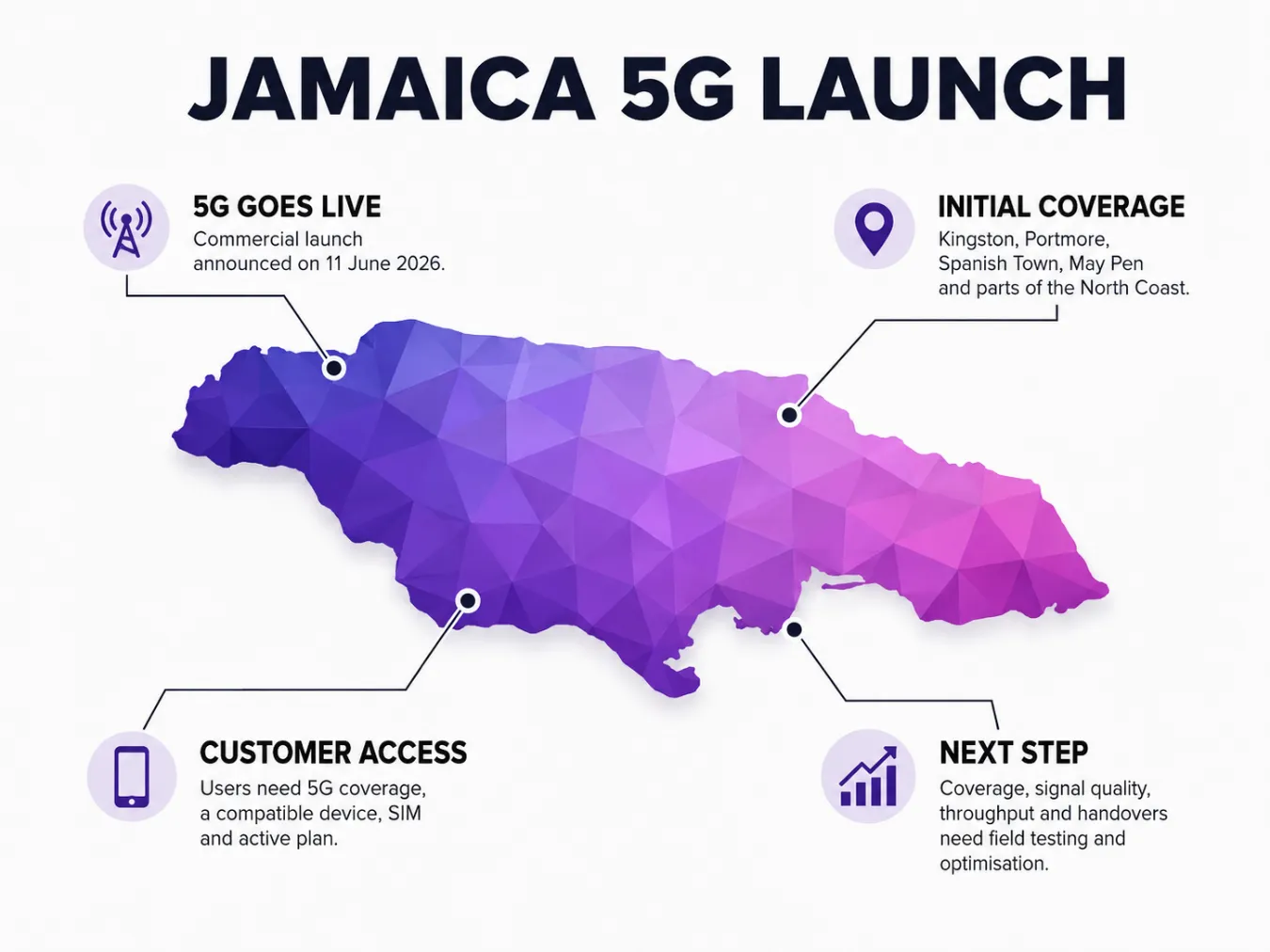
Jamaica’s first commercial 5G launch is a significant move for the country’s mobile sector. Flow switched on 5G on June 11, with service available across Kingston, Portmore, Spanish Town, May Pen and parts of the North Coast. The operator said the launch reaches around 70% of the population, while further rollout is planned for Mandeville, Santa Cruz, Black River, Savanna-la-Mar, Bull Bay and Morant Bay. So, now let us look into Can Jamaica’s 5G Launch Deliver Better Mobile Experience Beyond the First Coverage Areas along with Smart LTE RF drive test tools in telecom & RF drive test software in telecom and Smart Mobile Network Monitoring Tools, Mobile Network Drive Test Tools, Mobile Network Testing Tools in detail.
For users, the first expectation will be speed. Faster downloads, smoother video calls and better streaming are visible benefits. But the real test of a 5G rollout is broader. The network must work consistently in busy streets, residential zones, office buildings, tourist areas, transport routes and indoor locations where mobile signals are often weak.
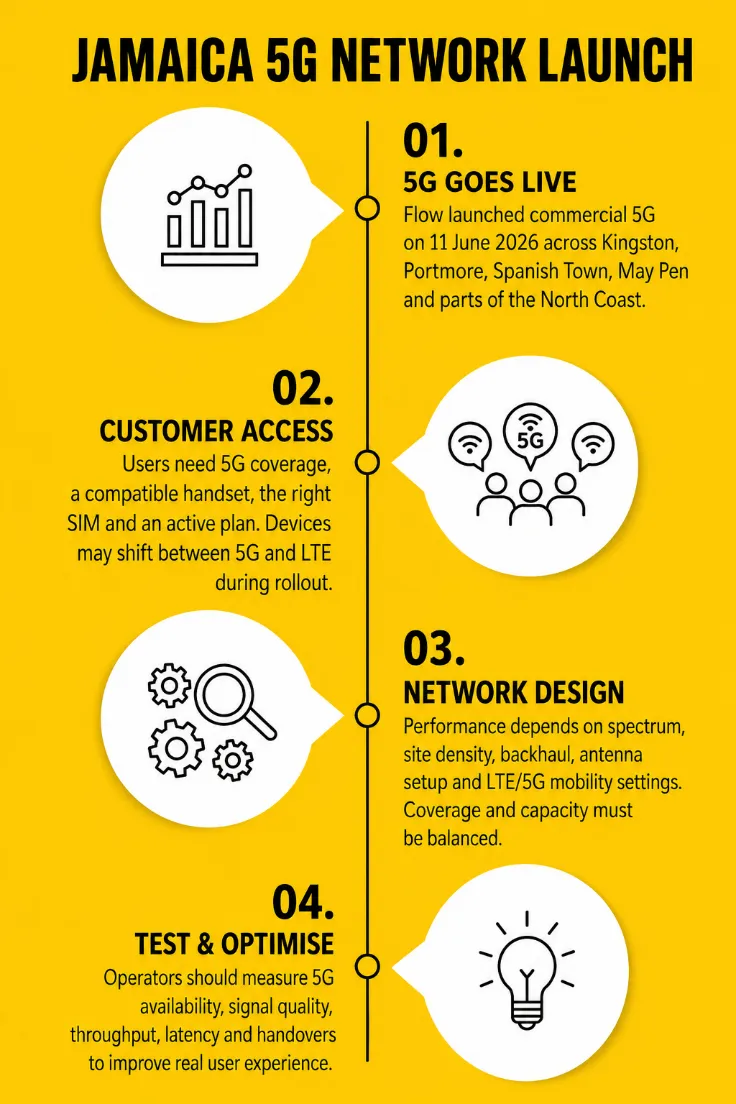
A commercial 5G launch does not mean that every customer will see 5G immediately. A user needs coverage at the location, a compatible handset, a suitable SIM and an active plan that supports the service. Even then, the phone can move between 5G and LTE as radio conditions change. This is normal behaviour in an early rollout, especially when the 5G layer is expanding site by site.
From a radio engineering view, Jamaica has a useful base for 5G deployment. The Spectrum Management Authority permits 5G NR under its IMT allocations, with sub-6 GHz bands such as 700 MHz, 1800 MHz, 2100 MHz, 2600 MHz and 3300–3800 MHz listed as commonly used 5G bands. Low-band spectrum can support wider area coverage. Mid-band spectrum can provide more capacity and higher data rates in populated areas. The final customer result depends on how the operator combines spectrum, site density, backhaul capacity, antenna design and LTE/5G mobility settings.
This is why launch coverage figures should be treated as a starting point, not a final answer. Population coverage is different from geographic coverage. A network can reach many people in urban and coastal locations while still having gaps along rural roads, hills, indoor spaces and remote communities. Jamaica’s terrain, building materials, power availability and exposure to severe weather all place practical demands on mobile network design.
The announced rollout also includes Voice over LTE and Voice over Wi-Fi, together with greater power and satellite support at mobile sites. These features matter because mobile experience is not defined only by a speed test. Call continuity, indoor availability, recovery after an outage and stable data sessions are equally important. A network that delivers high peak speed but drops calls, struggles indoors or loses service during a power event will not meet the full expectation of users or businesses.
For operators, the next phase should be measurement-led optimisation. Network teams need to check 5G availability, RSRP, RSRQ, SINR, throughput, latency, handover behaviour and service continuity across the launch areas. Testing should include fixed points, drive routes and indoor locations. Results should be compared by time of day, traffic load, device type and service scenario.
| Area | Jamaica 5G Launch Summary | Technical Focus |
| 5G Launch | Commercial 5G service was launched on 11 June 2026. | Initial rollout and service availability |
| Initial Coverage | Coverage includes Kingston, Portmore, Spanish Town, May Pen and parts of the North Coast. | Population coverage versus actual geographic coverage |
| Customer Access | Users require 5G coverage, a compatible handset, a suitable SIM and an active 5G plan. | Device capability, SIM provisioning and network access |
| Network Design | Customer performance depends on spectrum, site density, backhaul, antenna setup and LTE/5G mobility settings. | Coverage, capacity and handover performance |
| Voice Services | VoLTE and VoWiFi support can improve calling experience and indoor service continuity. | Call quality, indoor coverage and service availability |
| Network Resilience | Power and satellite support at sites can help maintain service during outages or severe weather. | Backup connectivity and site resilience |
| Field Testing | Operators need to measure 5G availability, RSRP, RSRQ, SINR, throughput, latency and handovers. | RF drive testing and customer experience validation |
| Next Step | The rollout requires continued testing and optimisation as new locations and users are added. | Network tuning, coverage improvement and performance tracking |
This is also where RF drive test software can help. Smartphone-based testing allows engineers to capture real user experience without relying only on network-side counters. A field team can validate whether a 5G indicator on the phone is supported by usable throughput, stable voice service and acceptable latency. The same workflow can identify places where LTE remains stronger than 5G, where a handover needs tuning or where indoor coverage needs attention.
Jamaica’s 5G launch is therefore not the end of a project. It is the start of a continuous process of rollout, testing, customer onboarding and optimisation. The strongest outcome will come when 5G coverage, device access, affordable plans and measured network performance improve together.
About RantCell
RantCell provides smartphone-based RF Drive Test Software for mobile operators, enterprises, system integrators, regulators, and private network teams. The platform supports 4G, 5G, private LTE/5G, CBRS, Wi-Fi, indoor walk testing, drive testing, benchmarking, cloud analytics, automated reporting, and network performance monitoring.
RantCell helps teams measure real network performance using RF and QoE KPIs such as RSRP, RSRQ, SINR, throughput, latency, handovers, call quality, and service availability. Testing data can be uploaded to the RantCell cloud dashboard for analysis, reporting, and optimisation. Also read similar articles from here.